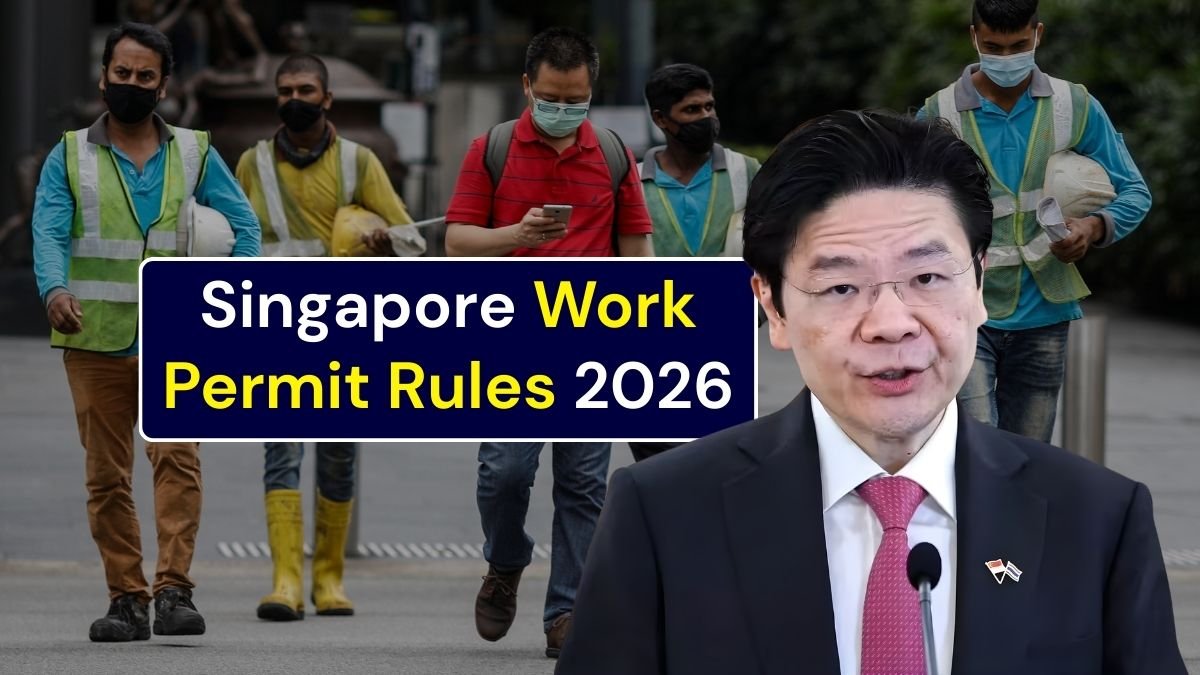
KEY HIGHLIGHTS
- Singapore updates Work Permit rules in 2026 with levy adjustments, quota controls, and stronger migrant worker protections.
- Foreign Worker Levy ranges between S$300–S$950 monthly; marine shipyard levy rises by S$100 and process sector by S$150.
- Employers must review quotas, maintain Local Qualifying Salary workers, and follow updated MOM compliance rules.
Singapore has updated its Work Permit framework in 2026, introducing revised levy structures, quota controls, and stronger worker welfare requirements.
These policies, overseen by the Ministry of Manpower (MOM), affect employers hiring migrant workers across sectors such as construction, manufacturing, marine shipyard, and services.
| Key Policy Area | 2026 Update |
|---|---|
| Foreign Worker Levy (FWL) | S$300 – S$950 monthly depending on sector and skill level |
| Marine Shipyard Sector | Levy increased by S$100 for basic-skilled workers |
| Process Sector | Levy increased by S$150 for basic-skilled workers |
| Local Qualifying Salary (LQS) | S$1,600/month minimum to count as a local worker |
| Worker Medical Insurance | Minimum coverage of S$60,000 required |
Overview of the Singapore Work Permit System
A Singapore Work Permit allows employers to hire semi-skilled or basic-skilled foreign workers from approved countries in specific industries.
Two regulatory tools control the size of the foreign workforce:
Foreign Worker Levy (FWL)
Employers must pay a monthly levy for each Work Permit holder.
Dependency Ratio Ceiling (DRC)
This sets the maximum percentage of foreign workers relative to local employees.
These policies encourage firms to improve productivity while maintaining employment opportunities for Singapore residents.
Foreign Worker Levy Changes in 2026
Levy rates vary based on industry sector, worker skill category, and the company’s dependency on foreign labour.
Typical levy charges fall between S$300 and S$950 per worker per month.
Under Budget 2026, the government introduced higher levy rates for selected sectors employing large numbers of basic-skilled workers:
- Marine shipyard sector: levy increase of S$100
- Process sector: levy increase of S$150
Companies exceeding their standard quota must pay higher levy tiers.
Employers should review their workforce mix carefully, as higher levies directly affect operational costs.
Updated Quota Limits for Foreign Workers
The Dependency Ratio Ceiling (DRC) determines how many foreign workers a company can hire.
Different sectors have different limits.
Services sector
Foreign workers are capped at roughly 35% of the workforce.
Construction sector
Companies can hire a larger number of migrant workers, with ratios allowing up to seven foreign workers for every local employee.
To qualify for these quotas, firms must employ locals earning at least the Local Qualifying Salary of S$1,600 per month.
Exceeding quota limits may lead to penalties or restrictions on new Work Permit applications.
Removal of Maximum Employment Duration
A notable structural change in recent policy updates is the removal of fixed maximum employment periods for many Work Permit holders.
Previously, workers could only remain in Singapore for a limited number of years depending on sector and nationality.
Under the revised framework, experienced workers can continue employment as long as employers renew their permits and meet regulatory conditions.
This allows companies to retain trained workers and reduce repeated recruitment and training costs.
Worker Welfare and Protection Improvements
Worker welfare has become a stronger policy focus.
Employers must meet stricter requirements covering healthcare, accommodation, and workplace safety.
Key rules include:
- Minimum medical insurance coverage of S$60,000
- Approved and regulated worker housing standards
- Compliance with workplace safety and fair employment practices
These measures aim to improve living and working conditions for migrant workers while maintaining industry standards.
Sector-Specific Hiring Rules
Different industries operate under slightly different Work Permit frameworks.
Construction sector
Employers must comply with additional requirements such as:
- Approved source countries
- Sector certifications
- Specialised levy tiers
Manufacturing and services sectors
Companies must manage quotas based on workforce composition and track hiring limits through the MOM online portal.
Regular monitoring helps employers avoid unexpected levy increases or quota breaches.
Why This Matters
Singapore relies on foreign manpower to support labour-intensive sectors while protecting opportunities for local workers.
The 2026 Work Permit updates reinforce this balance by:
- Encouraging firms to adopt productivity improvements
- Maintaining controlled foreign workforce growth
- Strengthening worker welfare standards
For employers, these rules directly affect hiring budgets, compliance obligations, and long-term workforce planning.
Businesses that track quota levels and levy costs early can avoid last-minute hiring disruptions.
Official information:
[Link to Official Source – Apply Here]
Frequently Asked Questions
What is the Foreign Worker Levy in Singapore?
The levy is a monthly fee employers pay for each Work Permit holder. Rates typically range from S$300 to S$950, depending on sector and worker skill level.
What is the Local Qualifying Salary requirement?
Employees earning at least S$1,600 per month count as one local worker when calculating foreign worker quotas.
Which sectors are affected by the 2026 levy increase?
The marine shipyard and process sectors face levy increases of S$100 and S$150 respectively for basic-skilled workers.
Can Work Permit holders stay longer in Singapore now?
Yes. The removal of maximum employment duration allows experienced workers to remain employed as long as permits are renewed and employers meet MOM requirements.
Where can employers check their foreign worker quota?
Employers can monitor quotas and levy tiers using the MOM online services portal.